Building a Healthy, Trusted CMDB: Your CMDB Should Be an Asset, Not a Liability
Imagine trying to navigate a complex city with three different maps, each showing conflicting streets and missing connections.
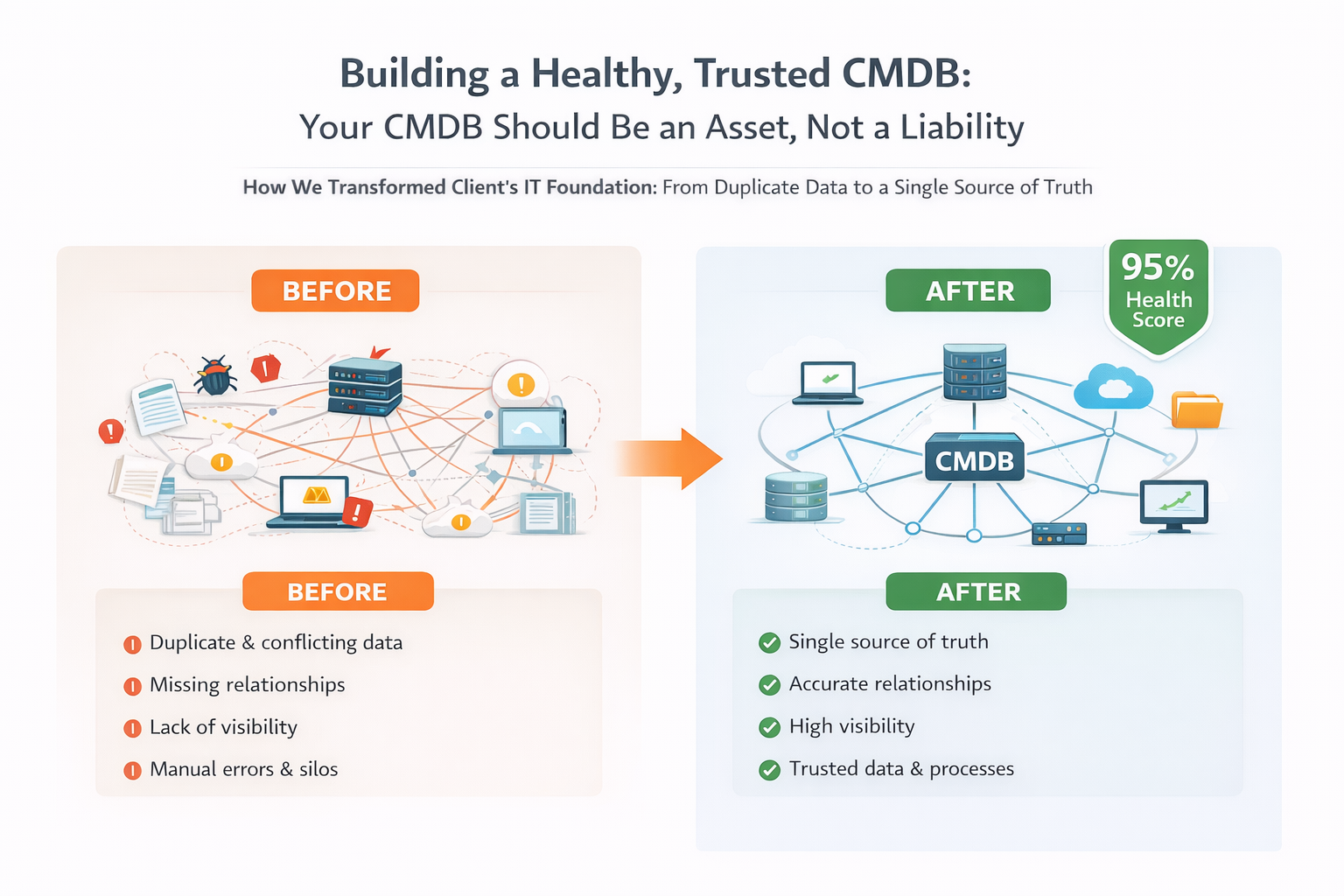
One of our Client’s IT teams were working with incomplete and inconsistent information. Their critical Configuration Items (CI), such as servers, laptops, and applications were spread across multiple tools like SCCM, SCOM, and JAMF. This led to duplicate records, mismatched data, and missing relationships between assets.
Because there was no single, accurate view of the IT environment, it was difficult to understand how systems were connected. When a business service went down, finding the root cause took extra time and effort, impacting both operations and service reliability.
The challenge was clear: without a trusted and well-structured CMDB, delivering stable and efficient IT services was becoming increasingly difficult.
The Core Pain Points
Client faced several challenges that made managing their IT environment difficult.
- The same assets were stored in multiple systems, often with different or conflicting information. This made reporting unreliable and hard to trust.
- Key relationships between servers, applications, and devices were missing, so teams had little visibility into how systems supported business services.
- Physical asset tags could not be properly linked to digital records, forcing teams to depend on spreadsheets and manual work, which led to errors.
- Over time, confidence in the CMDB declined. With outdated and incomplete data, IT teams could not rely on the system when making important decisions.
Business Impact
Incidents took longer to resolve, changes carried higher risk, and audits required significant manual effort. Without a reliable CMDB, IT teams were spending more time reacting to problems instead of proactively supporting the business.
Our Solution: Building a Reliable and Healthy CMDB
We focused on creating a CMDB that teams could actually trust and use, not just filling it with data.
- Smart Assessment and Integration
Instead of replacing existing tools, we reviewed the current setup and designed a cost-effective integration. Data from SCCM, SCOM, and JAMF was brought into ServiceNow and consolidated into a single, consistent view, while still preserving the client’s existing investments. - Defining and Building CI Relationships
We worked closely with Client’s IT teams to understand how their services, applications, and infrastructure were truly connected. Based on this, we created accurate and meaningful relationships in the CMDB, giving teams clear visibility into dependencies and service impact. - Connecting Physical Assets with Digital Records
To address asset tagging, we followed a two-step approach. First, we aligned existing assets with their physical tags through a one-time data clean-up. Then, we implemented a procurement and commissioning process so that all new assets are created with asset tag information from the start.
Outcomes: A CMDB Teams Can Trust
The improvements delivered real, measurable outcomes.
- 95%+ CMDB health score achieved by cleaning up duplicate, orphaned, and outdated records, making the CMDB a reliable source of truth.
- Over 95% relationship accuracy, giving teams clear visibility into how systems and services are connected.
- Stronger foundation for IT operations, enabling better incident impact analysis, change planning, and security improvements.
- Greater operational confidence, with IT teams able to quickly understand service dependencies and business impact before making changes.
Your Search for a First-Class Consultant Ends Here.
Searching for a First-Class Consultant?
CONTACT US WITH EASEGet in touch
Looking for IT solutions or support? You are always welcome to visit our office or drop us an email anytime. We will get back to you as soon as possible.